
Photo credit: Windsor-Detroit Bridge Authority
Canadians Remain Confident Gordie Howe Bridge Will Open Even as Trump’s Threats Sow Confusion
February 19, 2026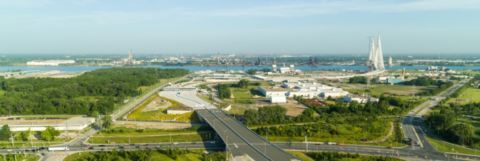
The World
February 18, 2026
Jeremy Siegel
If someone told you a decade ago that a bridge would become one of the biggest threats to US-Canada relations, you’d have called them bonkers. But those were different times.
In February 2017, when US President Donald Trump held his first official meeting with then-Canadian Prime Minister Justin Trudeau during his first term in office, the US-Canada relationship appeared amicable, as the two leaders discussed their countries’ deep diplomatic ties and a shared focus on building new things. The president tossed his support behind a long-sought effort to build a new link between Detroit, Michigan, and Windsor, Ontario, the busiest international trade crossing in North America. “America is deeply fortunate to have a neighbor like Canada,” Trump said in a press conference after the meeting. “We have before us the opportunity to build even more bridges and bridges of cooperation and bridges of commerce.”
Flash forward eight years, and a lot has changed. Construction on the Gordie Howe International Bridge is now virtually complete. Justin Trudeau is out of office and Trump is back in the Oval Office. Only now, rather than championing the bridge’s construction, Trump has become its biggest threat.
In a lengthy rant posted on the social media platform Truth Social last week, the president claimed Canada is “taking advantage of America.” He insisted that the US must be “fully compensated” and that it should own half of the infrastructure. The demands have baffled officials on both sides of the border, given that Canada fully funded the $6.5 billion project and the bridge is already jointly owned by Canada and the state of Michigan. White House Press Secretary Karoline Leavitt attempted to clarify the President’s stance, stating that “the fact that Canada will control what crosses the Gordie Howe Bridge and owns the land on both sides is unacceptable.” That explanation only deepened the confusion. Heather Grondin of the Windsor-Detroit Bridge Authority, the Canadian nonprofit overseeing the project, noted that Michigan already owns the land on the American side. The White House did not respond to requests for further clarity.
Canada’s current prime minister, Mark Carney, has remained measured. Carney told reporters he spoke with Trump recently to reiterate that Canada footed the bill, adding that he remains optimistic about the opening. Still, the threats have unsettled the business community in the Detroit-Windsor corridor, the busiest international trade crossing in North America. Some Canadian business leaders have declined to comment publicly, fearing political backlash.
Others, however, argue that the project is too important to delay. Glenn Stevens Jr., who leads the Detroit Regional Chamber’s automotive wing, emphasized that the bridge is a non-partisan modernization effort supported by three presidential administrations and multiple governors. “It really is to protect and enable the trade between our two countries,” Stevens said. “And to enable our long-term competitiveness.”
Despite the friction, many involved in the project view it as a testament to the deep ties between the two nations. Rob Trymbulak, a Canadian steelworker who helped construct the bridge, said the project is a great example of cross-border collaboration, as one side was constructed by a Canadian crew and the other by the US. “We had a really cool day, where we met the Americans in the middle and connected the last piece,” Trymbulak recalled. “That’s when it all came together and you really did feel the pride and the magnitude and the accomplishment.”
Eric Behrens, the bridge’s architect, pointed to the inclusion of pedestrian and bike paths as a way to connect people, not just cargo. He noted that Gordie Howe — a Canadian professional ice hockey player and a figure beloved in both Detroit and Canada — is the perfect namesake for the crossing. “In the end, it’s going to be a unifying symbol,” Behrens said.
It is a sentiment echoed by Gordon Orr, CEO of Invest Windsor-Essex. He believes the interdependency of the region — where families and workers cross the border daily — is stronger than any single administration. “We’ve always promoted this region as a two-nation destination,” Orr said. “It really is one community.” Meanwhile, as Orr remains confident the bridge will open, his immediate focus is elsewhere: seeing if Canada can take home the Olympic gold in Milan.