
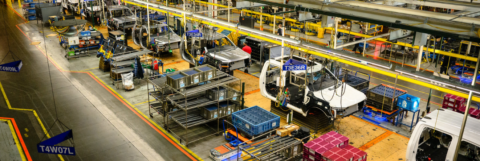
Picture credit: Alex Brandon/AP
Politico
Aug. 26, 2026
Daniel Desrochers and Oliver Ward
The auto industry would face an existential crisis if the U.S. and Canada don’t cool their trade war over the next four months. But the sector’s lobbyists are treading cautiously as they try to nudge the Trump administration back to the table.
The stakes are clear. Take Ford’s F-Series Super Duty truck, made in a new plant in Windsor, Ontario. Its transmission comes from Ohio. Its axles come from Michigan. Its engine comes from Ontario.
If the North American neighbors don’t resolve their differences by Jan. 1, President Donald Trump has pledged to hit the truck, its Canadian parts, and others like it with a 50 percent tariff when crossing the border, a result that would be “cataclysmic,” for the industry, according to one industry official who said companies would be forced to raise prices.
But as they wait for tempers to cool in Ottawa and Washington, carmakers are taking a soft touch approach to lobbying the Trump administration to abandon its trade war.
“We’re kind of regrouping,” said another auto industry official. “We just need to let both sides go back to their corners for a bit, and then figure out how to come back together.”
Both industry representatives were granted anonymity to describe private conversations.
The auto industry’s delicate approach highlights the rocky path for businesses caught in the crossfire of President Donald Trump’s trade agenda, particularly in the manufacturing sector, where the administration has been clear about its reshoring goals. The health of the industry is pivotal not just for the Trump administration’s economic message — where automaking is a potent symbol of the president’s promised industrial renaissance — but also the U.S. economy and the nearly 1 million people it employs.
Where U.S. companies in some industries like steel and aluminum are actively pushing for protectionist measures, the auto industry has long been wary of any tariffs that disrupt a highly-integrated North American supply chain.
“Reindustrialization is a real thing, and no one would argue that’s not a good thing for our countries,” said Glenn Stevens Jr., the Chief Automotive and Innovation Officer at the Detroit Regional Chamber. “The issue really for us has been here in Michigan is we want that, and we’ve seen some of that, but we really don’t want that at the expense of a trading partner that we’ve been with for, in the auto industry, almost 125 years together.”
White House spokesperson Kush Desai said Trump’s economic agenda has “secured billions in manufacturing investments from foreign and domestic automakers alike.”
“As the President has made clear, Canada and other trading partners cannot keep freeriding off of the United States, and the Trump administration will continue to put Americans and America First,” Desai said.
The auto industry was among the first Trump targeted with tariffs when he began his second term, imposing a 25 percent across-the-board duty on autos and auto parts on national security grounds early in 2025. They were also one of the first industries to push back. The “Big Three” U.S. automakers — Ford, General Motors, and Stellantis, which owns Jeep and Chrysler — were able to secure exemptions early in the process for automobiles and parts that were made in North America.
Those exemptions were critical, auto lobbyists argued, because parts and vehicles regularly move across borders between Canada, Mexico, and the U.S., sometimes several times. Under the terms of the 1994 North American Free Trade Agreement and its Trump 1.0 replacement, the U.S.-Mexico-Canada Agreement, most of that commerce was tariff-free. That integrated supply chain, auto companies have argued, has allowed North American cars to compete with overseas competitors, while also helping attract investments from major Asian manufacturers, from Toyota plants in Kentucky to Hyundai plants in Alabama.
But as Trump secured deals with other major auto manufacturing countries, like Korea and Japan, the North American auto industry soon found itself at a disadvantage, sometimes paying a higher tariff on vehicles than those that were built entirely in Asia and shipped across the Pacific.
The Trump administration was on the verge of a trade deal with Canada last week that could have lowered tariffs on Canadian automobiles to as low as 7 percent — a move that U.S. car companies were prepared to embrace, even as they continued to push for tariffs between the two countries to be eliminated outright. One of the industry officials called it a “welcome improvement” that would have removed what the industry sees as a competitive disadvantage vis-a-vis Asian manufacturers.
That came to a crushing halt Friday night when talks between Canada and the U.S. fell apart. Trump’s subsequent threat to raise tariffs on automobiles and auto parts to 50 percent on New Year’s Day added additional pressure. In the span of 72 hours, the industry went from cautiously optimistic to staring down what it described as an existential threat to North America’s competitiveness in the auto industry.
Even the group that would ostensibly benefit from a policy that brings more auto manufacturing back to the U.S. — the United Auto Workers Union — quickly panned the escalation.
“The UAW rejects any escalation on Canada, a country with strong unions and labor standards,” the union’s president, Shawn Fain, said in a statement. “If we’re going to increase tariffs anywhere, it should be on countries where automakers continue to offshore jobs because they can pay workers $3 an hour, force them to work in unsafe conditions, and crack down on independent unions.”