

MichAuto > Blog > Detroit Auto Show > Manufacturing Tech’s Evolution Through AI and Intellectual Property Ownership

Manufacturing Tech’s Evolution Through AI and Intellectual Property Ownership

January 16, 2026 Anjelica-Miller-headshot

Anjelica Miller | Manager, Communications, Detroit Regional Chamber

Top Takeaways

  • Leaders should center their AI roadmap on data strategy and intellectual property ownership, not just as efficiency tools.
  • Manufacturers of all sizes are currently using AI for predicting machine maintenance and dialoging dial logging while keeping humans in the loop to address unknown issues flagged by the AI.
  • AI strategy must be paired with a quality talent pipeline strategy, positioning technology as a multiplier for human expertise, not just for cutting costs.

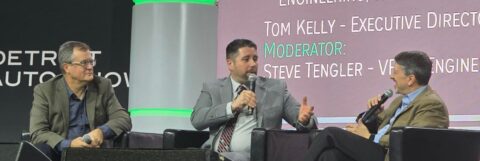
Closing out Industry Days at the 2026 Detroit Auto Show, Automation Alley’s Executive Director and Chief Executive Officer, Tom Kelly, and Nexteer’s Executive Director of Global Manufacturing Engineering, Kevin Douglas, sat with Envorso’s Vice President of Engineering Excellence, Steve Tengler, to discuss how manufacturing tech is evolving across the automotive and manufacturing industries.

Using AI for Plant Efficiency and Beyond

Kicking off the conversation, the trio discussed AI’s current and future strategic impact and how companies, regardless of size, could leverage it. Douglas explained that today’s primary short-term use in smaller manufacturers involves data aggregation to track quality and vibration analysis to extend machine motor lifespans. Even simpler, cheaper solutions include pointing a camera at an analog dial and having AI log the data.

“AI is very good at going through that data and finding correlations, telling us when things are drifting off the mean, and how to re-center them. It’s a lot of opportunity, but it creates a whole amount of other things we have to do,” Douglas said.

Douglas and Kelly also explained that large manufacturers tend to use the cloud, which raises cybersecurity and connectivity risks, requiring stronger protections around software as AI gets better at encoding process knowledge in these machines.

Kelly specifically advised those in manufacturing to “own your own destiny” by owning their own intellectual property (IP) in designs and patents, and by digitizing it for easier, more profitable distribution and production, similar to how Apple created FairPlay to monetize MP3 files.

“If we can figure out a way to protect IP so that I can have a widget and I can have it as a digital drawing in a CAD file … send you that CAD file … and you’re allowed to make one … or maybe you’re allowed to make 100,” he said, “then you get the margin, and I get the royalty, and the customer gets the product … I’ve now Amazon’ed manufacturing. And what does manufacturing become? An IP plan.”

Workforce, Talent, and Upskilling in an AI-Driven Plant

The trio also discussed the workforce development issues in the industry. Despite what some might say, there is a lot of opportunity for apprenticeships and upskilling for new and existing workers to use AI as an efficiency tool rather than just a job replacement. Douglas and Kelly suggested that removing repetitive work for some machinists and technicians can help them become more creative and engage in higher-value problem-solving and innovation, which supports IP creation for companies.

“We have lots of apprenticeships that we’re pushing people into to try to get more and more skilled trades and upskilling,” Douglas said. “Even the people we do have, we have had to do some retraining [from multimeters to IO-links for diagnostics].”

Further, the three experts implored the audience to improve the industry’s reputation among young people by showing them that these aren’t the messy, antiquated facilities “that their parents told them about,” but instead are filled with robots and automation on a much larger scale, beyond smart lights around the house. Kelly also specifically advised older employees and leaders to be open to learning from young people, as the young adults that are coming out of school are digital natives more so than not.

“The auto industry is one of the few places where you can use AI and software and see the fruits of your labor physically manifest,” Kelly said. “It’s really cool and really powerful, and that hooks kids.”