
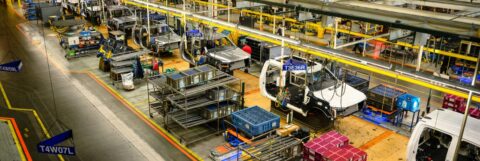
Pictured: Vehicle assembly progresses along the production line at the Ford Rouge Factory in Dearborn.
For more than a century, Michigan has been the center of the global automotive industry. That leadership was never guaranteed, and today it can no longer be assumed. Michigan vehicle production fell from roughly 2.7 million units in 2004 to about 2.0 million in 2024, even as southern states expanded output by nearly 60 percent and China grew its production more than sixfold. The state still holds extraordinary advantages, including 95 of the top 100 North American suppliers and an automotive sector that contributes approximately $348 billion to the economy each year. The question is not whether Michigan has the assets to lead. It is whether Michigan has the will to align around a shared strategy fast enough to convert those assets into the next era of leadership.
Michigan’s signature industry has reinvented itself again and again since the first vehicles rolled off the moving assembly line in 1913. More than a hundred years later, the state remains North America’s center of automotive innovation, home to the highest concentration of engineers, the greatest density of automation, and more research, development, and testing capacity than anywhere else in the world. That did not happen by accident, and it will not continue on inertia alone.
The mistake would be to treat those advantages as permanent. Leadership built over a century can erode in a decade if the pace of change outruns the pace of decision-making. The technologies, supply chains, and competitors defining the next era of mobility are moving faster than at any point in history. Michigan’s companies, universities, and innovation districts are ready to move with them, from the shop floor to the cloud. The real risk is not that the state lacks talent or assets. It is complacency, the quiet assumption that the industry Michigan built will always be its own.
“Michigan did not earn its place at the center of this industry by standing still, and we will not keep it by standing still either,” said Glenn Stevens Jr., executive director of MichAuto. “The assets are here. What we need now is the alignment and the urgency to put them to work, together, as one state.”
That charge is deliberately nonpartisan. Michigan’s leadership in automotive and mobility is not a Republican priority or a Democratic priority. It is the state’s shared economic future. Michigan faces a consequential election this year that will shape its agenda for years to come, and no matter who holds the governor’s office or the majority in Lansing, the industry that anchors the economy cannot become an afterthought. It employs Michigan’s neighbors, invests in its communities, and funds the public services families across the state depend on. Protecting and growing that leadership will take industry, labor, education, government, and economic development leaders working from the same strategy toward the same goal.