

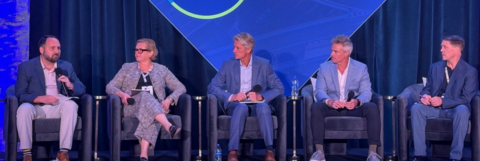
MichAuto Senior Director Drew Coleman moderated a panel during the CAR Management Briefing Seminars, featuring the State of Michigan’s Susan Corbin, Redzone’s Jon Lane, Festo North America’s Wilm Uhlenbecker, and IBM’s Kurt Wedgwood highlighting how AI and automation are not replacing workers but augmenting them, requiring urgent investment in skills, workforce development, and human-centered adoption to keep people at the core of increasingly intelligent, physical systems.
Kay Takeaways
- AI and automation are not eliminating jobs, they are enhancing human capabilities, with workers remaining essential for decision-making, problem-solving, and creativity.
- The biggest barrier to AI adoption is not building the technology, but developing a skilled workforce to deploy, maintain, and work alongside it.
- Humanoid robots are advancing and creating new opportunities in manufacturing, but for now their use remains limited and complementary, augmenting human workers in select environments while driving demand for skilled technicians.
- Michigan is positioning itself as a convener and catalyst, aligning infrastructure, education, and workforce partners to ensure AI-driven job transformation is supported by strong connectivity, digital literacy, and coordinated talent development, as jobs evolve rather than disappear.

Speaking to his experience visiting the Rossville plant as a kid with his dad, brother, uncle, and grandpa retiring from there, Coleman said, “I probably since I was eight, visited the plant every summer and every year the plan was different. So I think for us in the industry, this is not a new phenomenon. The differences here are that we should be able to learn from those past evolutions because companies that didn’t automate in any meaningful way are no longer here.
-Drew Coleman, Senior Director, MichAuto
The Future of Labor Is Human + AI, Not Human vs. AI
Jon Lane framed the “intelligence handshake” as a way to give frontline workers a competitive edge by pairing AI with human judgment.
“In light of all things we’ve talked about today, it’s how do I create a superpower in that shopfloor worker’s hand,” he said.
Assuming most workers want to do a good job, Lane explained that AI’s value lies in processing information humans can’t easily aggregate.
“You’re giving them a tool that really humans aren’t great at aggregating all sorts of data in your mind that’s happened over the past six months,” he said. “But AI may be good at that. And then you’re using the human to make the decision.”
At Redzone, that approach is already driving efficiency, with a goal of turning “five day’s worth of work to now be done in four over three months.”
Building on Lane’s “human + AI” approach, Wedgwood urged companies to actively embrace the technology. At its core, Wedgwood said progress starts by asking a simple question: “Is there a better way to do the work being done today?” The solution, he added, is to rely on human judgment to guide outcomes and “make that marriage of it.”
“I think that’s where we have the opportunity to take, which is repetitive work and AI could take that over,” he said, while noting that risks like safety must still be addressed.
Corbin reinforced that mindset by pointing to how leading organizations are approaching adoption in practice. The companies seeing success during the AI transition, she said, are the ones starting small and staying focused.
“They’re not thinking about everything,” she said. “They’re not thinking about how AI can work across all their operations.”
The Real Challenge Isn’t Technology – It’s Talent
At Festo North America, the biggest challenge isn’t the technology; it’s the workforce needed to deploy and sustain it. Uhlenbecker emphasized the importance of pairing talent with innovation.
“Sometimes when we talk about the approach, it’s ‘1+1=3,’” he said. “That’s exactly what I feel it is. It has to be the human capital combined with the technology advancement, which is key for success.”
To build that workforce, Uhlenbecker stressed the need to start earlier in the talent pipeline, noting that students must be exposed to “technical education and certain skill requirements that they will be at the forefront of and they will not be replaced by AI, and instead use it.”
Expanding on this, Corbin underscored the role employers play in shaping that pipeline, urging stronger connections with education partners to ensure alignment with industry needs. She emphasized the importance of engaging with local schools and CTE programs to determine if “they are doing something that meets your needs.”
“We are number one in the country for getting people skilled certificates. We are number three in the country for getting people into jobs,” she said. “So we are on a strong pathway. We just all need to work together cooperatively to make sure that we stay on that path.”
Have Humanoids Arrived Yet?
Highlighting rapid advancements in humanoid robotics, Uhlenbecker pointed to opportunities within manufacturing, particularly in tasks requiring two-hand coordination, where humanoids could operate alongside employees as “someone working next to a worker.”
“When you look back a couple years, it was trying to stand on two feet,” he said. “Now they run a half marathon in 150 minutes. They do backflips.”
However, he stressed that adoption remains limited. Due to high costs and safety considerations, humanoids are currently deployed in controlled environments, making their use “selective” for now.
Uhlenbecker also emphasized that success depends on the environment in which these systems operate, specifically, their ability to work alongside humans. Rather than replacing workers, humanoids are expected to complement them “because we don’t have enough.”
“We need much more skilled technicians in order to not just build them, but to deploy, program, and maintain them,” he said.
Michigan Has the Opportunity to Lead the AI Workforce Transition
At the state level, Corbin emphasized Michigan’s role in bringing stakeholders together to navigate the future of AI and automation.
“I think the best thing that we can do as the state of Michigan is be a convenor as we think about how we need to approach this work.” She pointed to the recently released AI Data Trends in Michigan report as a product of that collaboration, made possible by the community and worker economic transition office established two years ago.
Corbin also highlighted a major infrastructure investment supporting this transition, with the state committing $18 billion over the next two to three years to expand broadband access. A key component of that effort is digital literacy, “which we know if the basis of what we need to do as we make this AI transition.”
Building on that foundation, using last year’s Michigan’s AI and the Workforce Plan, she noted continued efforts to align workforce training with industry needs through partnerships with Michigan Works Agencies across the state. These collaborations are helping identify the skills workers need and where future investments should be made. Early data signals a clear trend: “Jobs are expected to evolve, not disappear.”