MichAuto > Blog > Advocacy > Whitmer at the 2026 Auto Show: Use Auto Industry as an Innovation Launchpad

Whitmer at the 2026 Auto Show: Use Auto Industry as an Innovation Launchpad

January 16, 2026 Anjelica-Miller-headshot

Anjelica Miller | Manager, Communications, Detroit Regional Chamber

Top Takeaways

  • Innovation, not isolationism, is Michigan’s strategic advantage.
  • A stronger talent pipeline is a non-negotiable strategy for Michigan’s advancement, and work is underway to improve access.
  • Recent efforts from the State of Michigan include releasing the first-ever Michigan Economic Transition Strategy and Whitmer’s latest executive order to begin studies on geologic hydrogen reserves for energy usage.

Kicking off the second Industry Day at the 2026 Detroit Auto Show, Gov. Gretchen Whitmer delivered her annual keynote address, covering the successes and challenges of the last year and what Michigan and the automotive and mobility industry as a whole need to do to maintain its global leadership. 

2025: Challenges and Momentum

Whitmer first addressed the industry’s top challenges that have emerged since her last keynote address at the Detroit Auto Show, including the implementation of new tariffs, which have imparted ongoing strain and uncertainty on Michigan’s business community and signature industry. Whitmer suggested a clear, stable strategy to tariff adjustments, saying “tariffs have their place, but they won’t magically restore American manufacturing.” 

“We need a strategic national trade policy that encourages competition, fosters innovation, creates jobs, and lowers costs,” she said. “A philosophy of ‘I win if you lose’ could lead someone to believe in the magical power of tariffs. But as we’ve seen over the past year, they don’t work alone. Nothing does.” 

With that, Whitmer also expressed support for renewing the U.S.-Mexico-Canada (USMCA) agreement, the free trade agreement created in President Donald Trump’s first term that strengthened collaboration among the three countries and is scheduled for formal renewal this summer. 

“We cannot and should not, as some have suggested, abandon [the USMCA]. Instead, we should build on the best parts and make it even better,” she said. “It raised wages for workers in all three countries and guaranteed that more parts were made in the U.S. Is it perfect? No. But without our allies, we do not stand a chance.” 

Related | MichAuto Advocates for Extension of Critical Trade Agreement, USMCA   

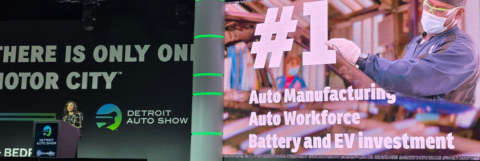
Whitmer also touted progress in Michigan’s automotive industry by doubling down on innovation, which includes the new, bipartisan state R&D tax credit and Innovation Fund. She also shared data from the 2025 MichAuto State of Automobility report, like Michigan remaining #1 in automotive manufacturing, R&D, and battery and EV investment. 

Related | Read the 2026 State of Automobility Report 

Innovation vs. China

Whitmer provided suggestions to move the industry forward and compete with other global leaders like China, which processes most of the metal, ore, and rare-earth materials used to build cars and has seen a 6.8 million-vehicle export increase in the past five years. To compete, one of Whitmer’s thoughts is to use innovation and collaboration together to advance the industry and Michigan as a whole. 

“Michigan is still home to some of the most exciting automotive research happening anywhere in the world,” she said. “We often talk about diversifying Michigan’s economy away from the auto industry, but the real secret is to use the auto industry as a launchpad for innovation.” 

Whitmer, along with the Michigan Community and Worker Economic Transition Office, announced the release of the state’s first-ever Michigan Economic Transition Strategy, connecting three priorities under a unified vision: industry growth and diversification, community resilience, and employee engagement and empowerment. It outlines programs and recommendations that will help Michigan prepare for economic change and take the next step. 

She also announced signing an executive directive to explore geologic hydrogen to make it a new source of clean, reliable energy in Michigan, saying if the reserves “are proven, safe, and viable, they could lead to a massive economic boom, creating jobs, lowering costs, and reducing our reliance on foreign fuel.” 

Talent Pipeline Within the Road Ahead

Closing out the keynote, Whitmer gave a look ahead into 2026, like working together to pass a balanced, bipartisan budget on time. She also emphasized that Michigan’s talent pipeline is a critical step in efforts to compete globally and set ourselves up for success. This includes the Going PRO program, the Community College Guarantee, and Michigan Reconnect — a program inspired by the Detroit Regional Chamber’s Detroit Reconnect — for which Whitmer called upon the Michigan House and Senate for a permanent renewal. 

She also warned against isolationism, encouraging everyone not to “shy away from the hard work” and to continue embracing change to create a better future for Michiganders. 

“Do we want to win together or risk losing by going [at it] alone? It will always be easy to retreat and stay in a silo,” she said. “We’re stronger today not because of our ability to change, but because of our willingness to embrace change and build a better future.”