


MichAuto > Blog > Advocacy > The Need to Be All in on Michigan’s Signature Industry: Automobility Day at the Capitol 2026

The Need to Be All in on Michigan’s Signature Industry: Automobility Day at the Capitol 2026

April 24, 2026 madison lorincz headshot

Madison Lorincz | Integrated Marketing Specialist, MichAuto

On April 21, MichAuto hosted its annual Automobility Day at the Capitol, gathering over twenty MichAuto investor companies in Lansing to meet with legislators and connect Michigan’s signature industry with policymakers. Throughout the day, conversations centered on the rapid technological change in the industry, fluctuating trade policies, uncertainty around EV adoption and infrastructure, the debate over data center proliferation in the state, and a growing skills gap in the workforce.

Against this backdrop, discussions highlighted the urgency of MichAuto’s Automobility Policy Roadmap to keep Michigan at the forefront of automotive and mobility innovation. The conversations reinforced a shared responsibility among MichAuto, its investors, and policymakers to collaborate on policy solutions and guide the roadmap’s execution over the next decade. Share your input to inform the Policy Roadmap.
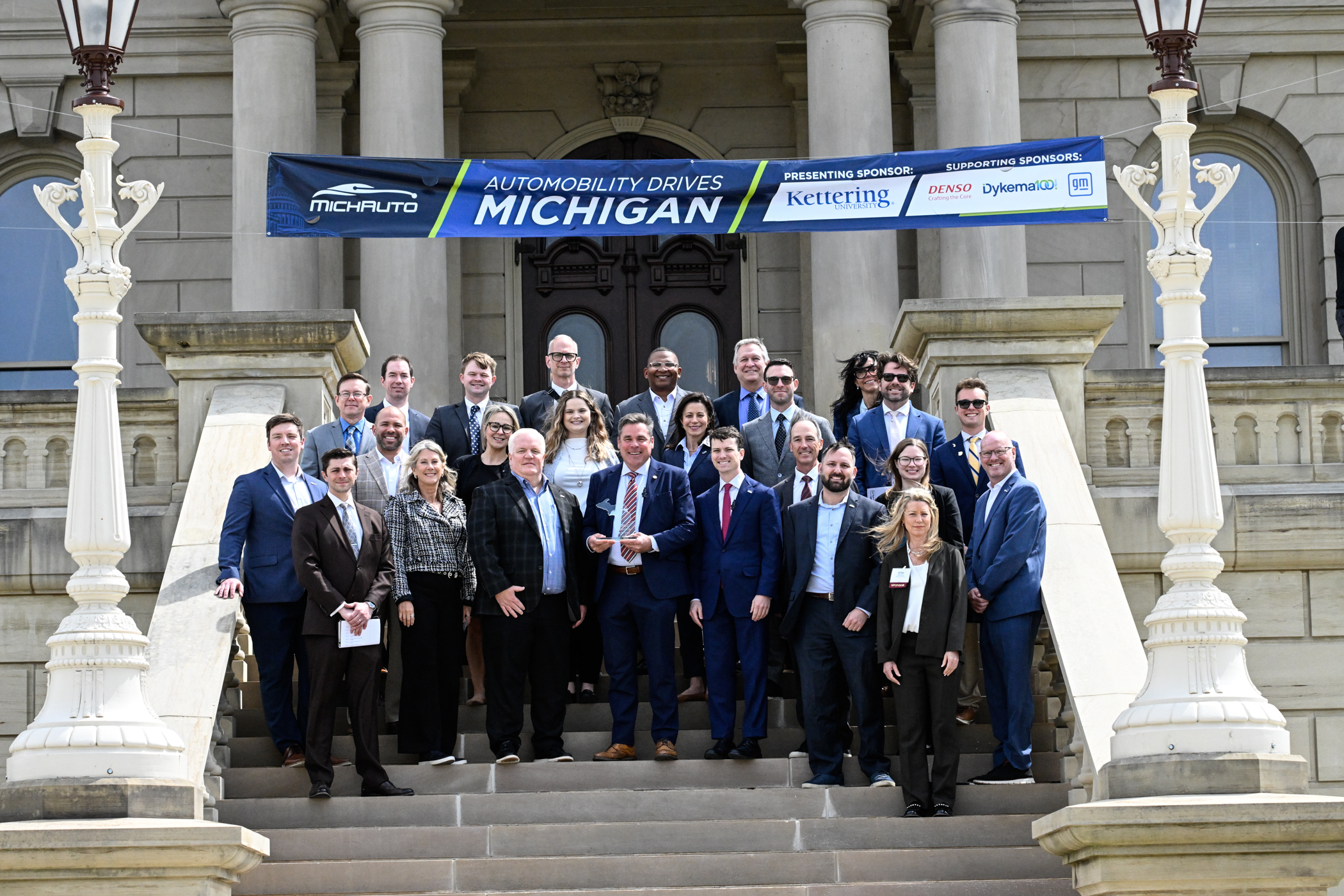
2026 Automobility Day at the Capitol


2026 Legislator of the Year

MichAuto also honored Sen. John Damoose (R-Harbor Springs) as its 2026 Legislator of the Year, which recognizes a state representative or senator who has made significant contributions to policy that has benefited Michigan’s signature industry, while seeking bipartisan consensus. As someone who grew up in the automotive industry and whose father worked at Ford Motor Company, Damoose appreciated every second he got to hear about his dad’s day at work, which ultimately laid the foundation for where he is today.

Featured Web (18)

Reflecting on the Michigan Senate’s approval of a $3.5 billion Ford investment to build a battery plant in Marshall, Damoose said, “There is no way in the world I was going to vote against this. This is our industry. This is a quintessential American industry, but it’s a quintessential Michigan industry.”

He added that supporting this initiative honored his father’s legacy at Ford and the industry that shaped Michigan.

Key Priorities Discussed

  • Michigan must diversify by building on its core automotive strength, not by turning its back on the industry it created.
  • Michigan needs a long‑term, bipartisan economic development strategy, supported by transparent, reliable, and accessible incentives for startups, suppliers, OEMs, and beyond, providing certainty across political cycles.
  • Dense proximity between OEMs and suppliers is a strategic advantage, reducing risk and cost while accelerating innovation and reinforcing the resilience of Michigan’s automotive ecosystem.
  • A strong business climate should benefit the entire economy, and companies must view investment through this lens, not solely individual bottom lines.
  • AI, automation, and software‑defined vehicles are reshaping workforce demands, requiring rapid upskilling and reskilling cross‑disciplinary talent spanning software, hardware, systems engineering, and cybersecurity.
  • Michigan must strengthen and protect workforce investments, including restoring funding for proven programs like the Going PRO Talent Fund and expanding apprenticeships, skilled trades, and real‑world learning.
  • Michigan must fully leverage its deep engineering and technical talent pool by aligning education systems statewide with real‑time industry needs.
  • Despite the pullback on electrification, electrification will continue globally and help define future leadership in vehicle production and design, charging infrastructure, energy generation, and battery technology.
  • Global competition, particularly from China’s expanding automotive footprint, demands urgency, as Chinese OEMs reshape markets through exports and manufacturing across North America, including in Canada and Mexico.
  • Michigan must remain unapologetically pro‑people and pro‑business to compete, retain investment, and lead the future of mobility.
  • Stable North American trade relationships are essential to competitive, integrated supply chains. Michigan should actively advocate for extending the U.S.-Mexico-Canada Agreement (USMCA) to provide long‑term certainty for cross‑border investment and production.
  • Michigan must modernize its infrastructure to remain globally competitive, including coordinated support for connected and autonomous vehicles and next‑generation mobility technologies.