

tariff resource center banner
MichAuto > Advocacy > Tariff Resources

Tariff Resource Center

The ongoing threat of tariffs is putting pressure on Michigan’s business community, negatively impacting Michigan’s signature industry. As Michigan’s only statewide voice for the automotive and mobility industry, MichAuto will continue to maintain its global leadership position. The Resource Center will guide you on how tariffs shape global trade, economies, and the automotive industry.

Oct. 17, 2025

The White House extended an agreement to five years that eases tariffs on automakers assembling vehicles in the U.S.

Oct. 6, 2025

President Trump announced a 25 % levy on medium and heavy-duty trucks imported from outside the U.S., to take effect Nov. 1.

Sept. 10, 2025

The Supreme Court agreed to decide whether a 1977 federal law giving the president certain emergency powers allowed President Donal Trump to levy tariffs on nearly all goods imported into the United States.

Aug. 29, 2025

The U.S. Court of Appeals for the Federal Circuit has affirmed a previous ruling by the Court of International Trade (CIT) from May, that determined the President lacked the authority under the International Emergency Economic Powers Act (IEEPA) to unilaterally impose tariffs. The Administration’s tariffs to remain in place till the U.S. Supreme Court begins it’s deliberations beginning in Nov.

Aug. 1, 2025

The Trump administration’s Aug. 1 deadline for reciprocal tariffs passed with a variety of major U.S. trading partners having already reached new trade agreements. These include the European Union, Japan, South Korea, and Vietnam. Significant countries still without a deal include Canada, Mexico, and China. Though current tariff rates are being extended with both China and Mexico as negotiations continue.

Read MichAuto’s response on the latest trade developments and tariff agreements.

July 29, 2025

The U.S. and Japan struck a trade deal, with tariffs being reduced from 25% to 15%, sparking renewed competition between Detroit and Japanese automakers as the latter seeks to expand its production in the United States.

July 7, 2025

President Trump signs an executive order delaying the implementation of his proposed reciprocal tariffs, originally set to take effect on July 9, until Aug. 1.

June 5, 2025

President Trump announces a 50% tariff on steel and aluminum imports, doubling the previous 25% rate.

May 28, 2025

The Court of International Trade rules Trump administration’s use of the International Economic Emergency Powers Act (IEEPA) to institute sweeping tariffs is illegal. The Administration immediately appeals the decision to the U.S. Court of Appeals for the Federal Circuit. As a result, the Federal Circuit Court has issued a stay on the lower court’s ruling. Lastly, the case will proceed through the appeals process, which could reach the Supreme Court, determining the future of these tariffs.

May 14, 2025

The administration reduces the US tariff rate to 10 percent from 125 percent of the cumulative tariffs under IEEPA imposed on certain imports from China on April 5, 9, and 10. The administration reduces China’s tariff rate to 10 percent from 125 percent of the cumulative retaliation to the IEEPA tariffs China had imposed on April 10 and 12.

April 29, 2025

President Donald Trump signed two executive orders that reverse course on some of the tariffs imposed on imported cars and car parts.

Read MichAuto’s response to the automotive tariff changes and how it will help preserve the industry’s global competitiveness at a time of critical transition and investment.

April 9, 2025

April 2, 2025

President Trump announces “Liberation Day” tariffs, which set 25% on all vehicles and a baseline 10% tariff on all imports, as well as worldwide reciprocal tariffs.

Read MichAuto’s response to the “Liberation Day” tariffs and how the tariffs will raise the prices of vehicles.

March 26, 2025

The Trump Administration announces 25% on vehicle import tariffs to take effect on April 2.

Read MichAuto’s response to the vehicle import tariffs and the impact the tariffs will have on consumers, production, and jobs.

March 5, 2025

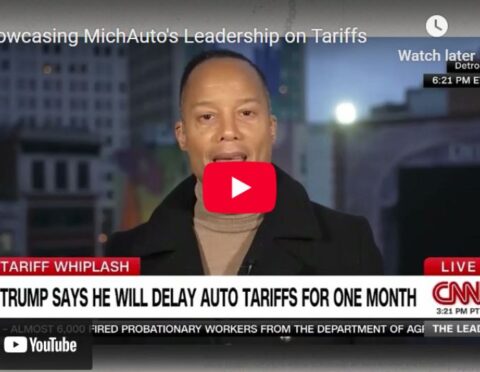
The Trump Administration announces a one-month delay for tariffs on automotive-related trade between the U.S., Canada, and Mexico.

Read MichAuto’s response to the auto tariff delay and what this means for the state’s signature industry and economy.

Feb. 10, 2025

President Trump signs an executive order to impose 25% on steel and aluminum tariffs to take effect on March 12.

Read MichAuto’s response on the potential consequences the steel and aluminum tariffs present for Michigan’s automotive industry.

Feb. 3, 2025

The Trump Administration announces a delay on 25% tariffs on imports from Canada, Mexico, and China.

Feb. 1, 2025

President Trump signs an executive order to impose 25% tariffs on imports from Canada, Mexico, and China.

Read MichAuto’s response to the detrimental effect the tariffs will have on Michigan’s automotive industry.

December 2025 Detroiter Magazine: Woven Together

Detroiter Dec 2025 Ad_Web Feature

Don’t miss the latest Detroiter magazine, which highlights the importance of U.S.-Canada trade and its disproportionate impact on Michigan. Experts from both sides of the border, including MichAuto’s Executive Director and the Detroit Regional Chambers Chief Automotive and Innovation Officer Glenn Stevens Jr., offer historical perspective on this critical trade relationship.

Read the latest Detroiter Magazine.

MichAuto Advocates for Extension of Critical Trade Agreement, USMCA

Paul Corbett and Matt Bluntt

On Dec. 4, MichAuto’s Director of Government and Community Affairs, Paul Corbett, was in Washington, D.C., to provide comment on upcoming U.S.-Mexico-Canada Agreement (USMCA) renegotiations. Corbett presented on behalf of the state’s automotive and mobility industry before the United States Trade Representative to ensure the agreement is thoughtfully renegotiated and extended. The three countries are expected to begin these discussions in July 2026.

Why it Matters: Michigan bears a disproportionate economic risk to trade policy disruption and fluctuation. The USMCA is a bedrock of industry resilience and an essential tool for maintaining productive trade relationships and economic vitality across North America. The key industry stakeholders MichAuto represents continue to rely on the certainty this critical trade agreement provides to make long-term, capital-intensive investments that bolster Michigan’s economy.

View Corbett’s testimony, as prepared for delivery.


Analysis