
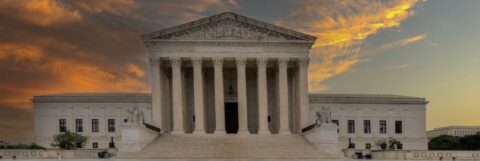
This week, the U.S. Supreme Court heard oral arguments in the case of Learning Resources v. Trump. The case concerns President Donald Trump’s use of the International Emergency Economic Powers Act (IEEPA) of 1977 to impose tariffs on most U.S. trade partners, which is having a major impact on trade and the automotive industry.
To date, the use of IEEPA has been challenged in the U.S. Court of International Trade and the U.S. Court of Appeals for the Federal Circuit, where it was ruled to be an insufficient legal basis for the President’s tariff policies. The subsequent Supreme Court decision could strike down, or uphold, a significant portion of the President’s trade agenda, which has far-reaching implications for MichAuto members.
The crux of the case may rest on the “major questions doctrine.” The doctrine holds that when the federal government asserts authority considered to be of “vast economic and political significance,” it must be directly and plainly authorized by the U.S. Congress. Courts have also considered the novelty of the authority being claimed, for example, whether there is a history of federal agency action and corresponding persistent congressional inaction.
Thus far, those challenging the use of IEEPA to impose the President’s sweeping tariff policies have argued and won because it fails to meet the doctrine’s test, as nowhere does the law mention nor have previous presidents utilized it to impose them. During oral arguments thus far, Supreme Court Justices, including conservative-leaning Justice Neil Gorsuch, have questioned the limits to the President’s power, should the U.S. Supreme Court uphold the Trump administration’s broad use of IEEPA.
There are some serious arguments in favor of the President’s use of IEEPA as an appropriate means to impose tariffs. For one, IEEPA does make fairly explicit the President’s authority under the auspices of national security to intervene in international trade, specifically stating that the President may “regulate … importation [of] any property in which any foreign country or a national thereof has any interest by any person.”
So, while the word tariff is not mentioned, those arguing on behalf of the Trump administration will assert that the phrase “regulate importation” is a clear reference to the concept of tariffs. That this power is expressly linked to the President’s near-unilateral authority to safeguard national security as well as conduct foreign policy, a widely beloved judicial principle, may further bolster the Trump administration’s case.
A decision from the High Court is expected before the end of 2025.
MichAuto has been outspoken about the impact of tariffs on the automotive and mobility industry and will continue to inform investors about the issue as it develops.