

Top Takeaways:
- Michigan’s government, industry, and education institutions’ cross-collaboration is vital to positioning the state as an innovation hub within the mobility sector.
- Education and workforce development must evolve as rapidly as new technologies.
- The future of mobility demands early exposure to and well-rounded knowledge of hybrid skillsets.
Michigan’s Leadership in Mobility Innovation: How Policy, Industry, and Academia Are Shaping the Future
As the global mobility landscape transforms under the influence of electrification, advanced digital systems, and intelligent infrastructure, statewide leaders are working to ensure that Michigan builds upon its rich manufacturing and innovation legacy, to remain competitive and at the forefront of global automotive and mobility innovation.
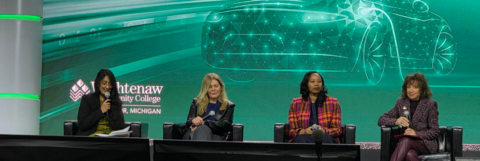
During a panel discussion at the 2026 Detroit Auto Show, representatives from higher education, state government, and industry shared insights on how collaborative strategies are preparing Michigan’s workforce for this new era.
Building Future-Ready Talent Through Industry Alignment
Rose B. Bellanca, President of Washtenaw Community College (WCC), opened the discussion with how WCC has expanded its programs, including cybersecurity, data analytics, and advanced manufacturing, to meet rapidly shifting industry needs. WCC’s approach is driven by an “outside‑in” strategy, continuously engaging with employers. This ensures that students’ learning experiences align with both workforce demands and learner aspirations.
Policy, Innovation, and the Future Mobility Workforce
Michigan’s Chief Mobility Officer Justine Johnson focused on the state’s responsibility to build its manufacturing legacy while preparing workers for the future of mobility in all its various facets as they focus their strategy on early investment and exposure within the K-12 pipeline.
“For the [Office of Future Mobility and Electrification], mobility is very broad as a term,” Johnson said. “It is anything that utilizes clean energy to move people, to move goods, and to move information across verticals like land, water, and air.”
The state has strategic partnerships, including the Detroit Regional Chamber’s own MichAuto program, to introduce students to advanced mobility careers earlier than ever. Initiatives such as the STEM Center at Lockwood High School allow students to explore high-tech opportunities tied to EV battery development, clean energy, and intelligent transportation systems through interactive learning.
Industry Perspective: The Need for Hybrid Skill Sets
Jennifer Tisdale, Senior Director of Strategic Engagements for Upstream Security and former Chief Executive Officer of GRIMM Cyber, highlighted the profound shift toward software-defined vehicles (SDVs) and cyber‑physical systems as today’s vehicles are increasingly characterized as “moving computers”, highlighting how cross-functional competency is increasingly necessary for the future of mobility.
“We’re seeing tech change the manufacturing process just as fast as we’re seeing it change the transportation industry in terms of vehicles. And what I mean by that specifically is think about any factory floor, a smart factory floor is filled with robotics, the APIs, and other forms of digital communication.”
As a result of intensified global competition, the mobility sector expects workers with interdisciplinary skills and robust training pipelines – areas where collaboration between academia, industry, and state agencies can benefit Michigan.