

- AI should not be viewed as a replacement for humans but as a force that will reshape how we think and create, potentially diminishing traditional ideation skills as younger generations rely more on AI to generate work.
- While AI literacy and new skill sets are essential, the technology is expected to displace more jobs than it creates, with human roles evolving to complement AI rather than being fully replaced.
- The path forward will require continued investment in human talent, strategic adoption of AI by businesses, and proactive policymaking to ensure the benefits of AI are broadly shared.
Top Takeaways
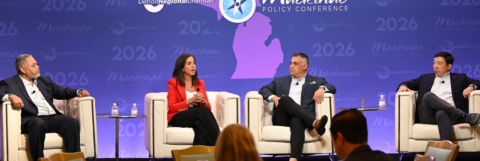
Panelists and Moderator


AI at the National Level: Where Michigan Can Lead
Entrepreneur and Bestselling Author Andrew Yang of the Forward Party kicked off the conversation with a tech-focused talk on how he sees AI reshaping the future of the workforce, education, and revenue generation, drawing on insights from across the U.S., particularly Silicon Valley.
He explained that unprecedented investment in AI is pushing companies to replace workers to maximize returns, potentially leading to widespread job loss. As he put it, “You’re going to see a mass reduction in the workforce, first in technology, and then some of the banks are going to start automating, very, very quickly.”
He also noted that “the easiest people to fire are the people you haven’t hired yet,” highlighting why many students are graduating with growing uncertainty about their job prospects. According to Yang, this shift is already reflected in a dramatic change in hiring expectations, with student placement rates dropping from “80% to 20%.”
On higher education, Yang warned that many institutions are already under pressure.
“About 60 schools are going to close this year,” he said, noting that less competitive institutions will face increasing challenges as the return on investment for entry-level white-collar jobs declines. As fewer of these roles offer strong salaries or long-term stability, the financial value of a college degree becomes less certain, further straining schools that rely on consistent enrollment.
Finally, Yang argued that current tax structures are misaligned with this new reality. He suggested that while workers continue to shoulder the tax burden, AI-driven companies can generate significant profits with relatively little taxation. To address this, he proposed shifting taxes away from labor and toward AI and automation, with the revenue redistributed through mechanisms such as a national wealth fund.
“There’s a window of time when we might be able to improve the human condition if we take all of this work that AI is doing and actually get revenue from it,” Yang said. “Right now, we’re not set up to get revenue from it. We’re set up for the worst of all worlds, where they suck up the work, and then people are left looking around, like, where did the work go, and we’re all paying taxes ourselves.”
AI vs. Humans Is the Wrong Question
Much of the conversation around AI is framed as an “either-or” scenario, but Yang challenged that perspective, emphasizing how AI and humans can coexist. He noted that “AI is going to do a lot of the higher-ordering thinking and drafting for us, which is going to reduce our capacity to do those things.”
He also highlighted a generational shift in how young people approach ideation. Comparing today’s students to previous generations, Yang emphasized that many may never experience starting with a blank page and creating something from scratch, signaling a fundamental change in how creativity and problem-solving skills are developed.
The Reality of AI: Job Loss, Job Creation, and Human Value
Sharing insights on how AI will impact the future workforce and when it should be introduced, Ronia Kruse of Optech, LLC, Companies, and Digital Lakes emphasized the importance of early adoption.
“AI literacy is a skill everybody should have, no matter where you are in the workforce,” she said.
Kruse outlined the evolving mix of skills required in an AI-driven economy, including technicians advancing smart tools, cognitive roles, and human-centric jobs that leverage AI for tasks such as scheduling and diagnostics. As this shift continues, she noted that “A lot of kids are coming out of school not working within their professions.”
On the question of whether AI is a job creator or a job killer, Yang was direct: “categorically, AI is a job killer.” While he acknowledged that AI will create some new roles, he added that “it’s going to be vastly outnumbered by the folks that get eliminated or never get hired.”
From a manufacturing perspective, OnTrac AI Ajay Chawla shared that he is currently seeing a lot of “human in the loop. We’re not seeing AI replacing the full job yet.” There still needs to be humans making those decisions and creating those relationships.” At the same time, he noted AI’s impact on efficiency, particularly in areas like competitive analysis, work that would otherwise require thousands of people.
Chawla also warned that resisting AI adoption carries its own risks: “The more a company denies AI or tries to keep it out, the further they’re going to fall behind, and people will leave those companies anyway. So they have to accept it at some point.”
AI’s Next Chapter
Rounding out the conversation, Kruse emphasized the importance of investing in human-centered roles. She shared her focus on continuing to “develop people into roles where they can thrive, and hopefully Michigan will be the place they can live, work, and play.”
From an AI company perspective, Chawla noted that human talent remains a top priority. He shared that the “amount of humans he’s hiring far outweighs the amount of spending on AI right now,” and expects that to continue, using AI primarily to enhance capabilities such as competitive analysis and coding.
Finally, Yang pointed to a broader opportunity for Michigan to take a leadership role in shaping AI policy. He encouraged the state to “start proposing some kind of sensible policy at a state level,” while acknowledging the industry’s resistance to fragmented regulation, noting that “the AI industry doesn’t want any state regulation, which on one hand is sensible because you don’t want a hodgepodge patchwork of 50 different regulatory regimes.”
At the same time, Yang emphasized the state’s leverage, calling it a “golden opportunity” whenever policymakers introduce new ideas, because “you’ll actually have a bargaining position vis-à-vis the AI giants.”
Ultimately, he argued for a more inclusive approach to the future of AI, stating, “The government needs to hash out a grand bargain that leaves people feeling like they’re included in the future. Like they’re benefiting from AI.”
The 2026 MichAuto on the Island Industry Stakeholders Roundtable was sponsored by presenting sponsor KPMG LLP and supporting sponsors BCG, Denso, GS3, Nexteer Automotive, Toyota Motor North America, and Walbridge.