MichAuto > Blog > MichAuto News > ‘TikTok on Wheels’: With China Threat Escalating Senators Slotkin and Moreno are Reaching Across the Aisle

‘TikTok on Wheels’: With China Threat Escalating Senators Slotkin and Moreno are Reaching Across the Aisle

May 13, 2026

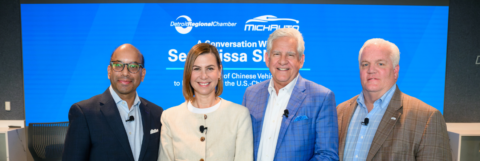
For national security and economic reasons, Chinese automakers must not be permitted to sell their cars in the United States any time soon, U.S. Senator Elissa Slotkin (D-Michigan) warned during a roundtable discussion at Detroit Regional Chamber’s headquarters on May 7.

View the event video below.

Slotkin, a first-term Democrat and former CIA intelligence analyst, touted the recently proposed Connected Vehicle Security Act – co-sponsored by U.S. Senator Bernie Moreno (R-Ohio) – as a way of preventing President Donald Trump or his successors form allowing China access to the American market without severe restrictions.

“A Chinese BYD vehicle is TikTok on wheels,” said Slotkin, comparing the popular Tesla-like electric car to the social media platform whose forced sale came after Congress required its original, Chinese owners to divest.

In Slotkin’s nightmare scenario, Chinese cars with sophisticated technology would be even worse than a social media app. “That vehicle, as you all know, also has 3D mapping, full-motion video, LiDAR, it has geolocation for whoever’s driving it. And then, if you’ve got a Bluetooth device in your pocket, as most of us do, it can be remotely hacked and piloted from Beijing.”

‘China Cannot be Trusted to Adhere to U.S. Law’

The impetus for the Slotkin-Moreno bill, the Senator said, was an appearance by Trump at the Detroit Economic Club in January at which he suggested he might be willing to let China sell its cars here if they are manufactured in the U.S. Slotkin says she’s worried the president might use that as a negotiating concession in trade negotiations in Beijing later this week.

Making the cars here is not good enough, Slotkin said, because China cannot be trusted to adhere to U.S. law regarding the capture and use of personal data.

The Slotkin-Moreno bill seeks to limit China to owning a maximum of 15% in any joint venture it might enter to build or sell cars here and to prevent Chinese cars from entering the U.S. from Mexico or Canada.

“There are lots of people in this room hellbent on building really, really technologically advanced vehicles, but here’s the thing: they’re subject to American law,” she said. “I believe that the standards that our American companies, and even our allies, live under are fundamentally different than the Chinese.”

Chinese Overproduction and Dumping Threatens U.S. Market

There also are significant economic concerns, as Chamber Chief Executive Officer Sandy K. Baruah and MichAuto Executive Director Glenn Stevens Jr. discussed when they joined Slotkin for a panel discussion with Emmy-award winning journalist Guy Gordon.

Slotkin described how China permits the theft of intellectual property and then subsidizes its auto industry to the point that the BYD retails for $11,000 in Europe. That figure made Gordon gasp.

“The term that hasn’t been used is what the Chinese are doing: dumping,” Baruah agreed. “Because of the heavy subsidies, they are selling their products across the planet at far below market rate, far below their actual cost level. … The strategy of the Chinese government is an intentional overproduction of vehicles. By how much? Their market demands about 25 million, but they build about 34 million and have a capacity for 50 million.”

Stevens reiterated Slotkin’s urgency to address the matter quickly.

“If you don’t draw a line now, it’ll be too late,” Stevens said. “This is not just a Detroit issue. This is a national issue, because it does impact those other companies from other countries, like Honda, Hyundai, Mercedes, BMW, that use American workers and build here, and they do it the right way. They’re part of the market, too.”

‘National Security Supersedes Environmental Concerns’

Gordon also pressed Slotkin on the idea that allowing inexpensive Chinese electric cars to come in would help reduce greenhouse gas emissions and assist with the fight against climate change. “How
do you balance that?” he asked.

“My responsibility as a leader is to protect American citizens and the American homeland, and I see these vehicles and those packages inside them as a threat,” she answered. “To me, that supersedes environmental concerns and a desire to have more electric or connected or autonomous vehicles in the United States. Do you think that I was popular [as a U.S. House member] when I voted to ban TikTok? You can imagine the number of kids who have never called their Congressperson in their lives, they were big mad about it.”

Steve Friess is a metro Detroit freelance writer who contributes to the New York Times and other publications.